
Biogas Leak Detection: How to Spot, Troubleshoot and Repair Leaks in AD
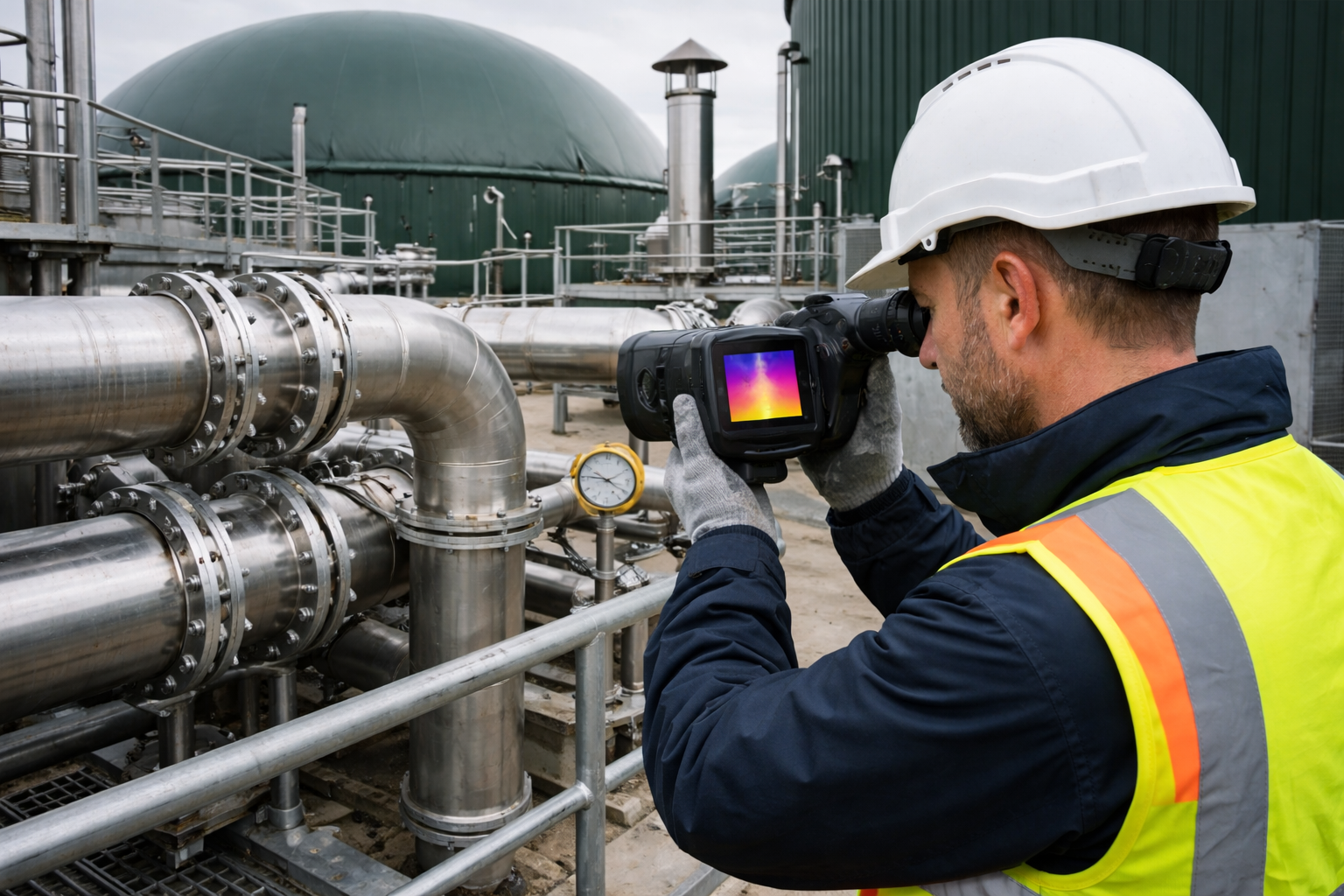
If your anaerobic digestion (AD) plant appears to be running well, it can be easy to assume there are no gas leaks. The digester is full, the gas holder is pressurised, and production figures look broadly acceptable. But the evidence from across the UK and Europe tells a different story. Around 85% of AD plants surveyed in the UK and Germany were found to be suffering from some level of biogas leakage. That figure, based on surveys of nearly 1,000 plants over eight years, is hard to ignore.
The problem is that biogas leaks are often invisible. Methane is colourless and odourless in its pure form, and many leaks are small enough that operators simply do not notice them during routine walkarounds. Yet even a modest leak carries real consequences: lost gas yield, reduced revenue, environmental permit risk, and the ever-present safety concern of methane accumulating in a confined space.
This guide walks you through how biogas leaks develop, where to look for them, how to assess their severity, and what a proportionate response looks like. It applies across plant types, from agricultural digesters on farms to food waste facilities and municipal sewage treatment sites.
Why Biogas Leaks Matter More Than Operators Often Realise
The case for taking leak detection seriously starts with money. Losing just 1 m³ of methane per hour translates to roughly £5,000 in lost revenue every year. That is a conservative estimate based on current energy values, and it applies to a small leak. Larger losses compound quickly, particularly on plants already operating on tight margins.
Beyond the financial impact, there are three other risk categories that every operator and plant owner needs to keep in mind:
Safety
Methane and air can form an explosive mixture within a concentration range of roughly 5 to 15% in air. In a poorly ventilated area near an ignition source, that creates a serious explosion hazard. Biogas also contains hydrogen sulphide (H₂S), a toxic gas that is heavier than air. It accumulates at low levels in confined spaces and can cause rapid incapacitation without warning.Environmental compliance
Methane is a potent greenhouse gas, with a global warming potential approximately 80 times greater than carbon dioxide over a 20-year period. The Environment Agency (EA) and equivalent regulators across Europe are increasing scrutiny of fugitive emissions from AD sites. For plants operating under an Environmental Permit, uncontrolled leaks can put permit conditions at risk.Revenue certification
Plants receiving payments under subsidy schemes such as the Renewable Heat Incentive (RHI) or the newer Renewable Gas Guarantee of Origin (RGGO) framework may be required to demonstrate that the plant is operating sustainably and that gas losses are managed. A well-documented leak detection and repair (LDAR) programme supports that compliance position.
Where Leaks Are Most Likely to Occur
No AD plant is completely leak-proof. Every site has inherent weak points, and these tend to cluster around connections, penetrations, and components that move or flex over time. Knowing your high-risk areas is the first step in building an effective inspection approach.
| Plant Area | Typical Leak Points | Applies To |
|---|---|---|
| Digester roof / membrane | Membrane fixation points, inner membrane tears, air inflation connections, cable grommets for agitator cables | All plant types |
| Concrete roof digesters | Cracks in concrete (common cause), leaking gaskets at agitator and pipe penetrations, pressure relief valves | Agricultural, food waste, municipal |
| Pipework and flanges | Flange connections, valve stems, pipe joints and welds, any area disturbed during maintenance | All plant types |
| Gas holder | Flexible seals, vent points, pressure relief valve gaskets, open ball valves, missing water seals | All plant types |
| Agitators and mixers | Mechanical shaft seals, agitator wires (particularly if lubrication is lacking), housing connections | Agricultural, food waste |
| CHP unit and gas supply pipework | Engine enclosure joints, biogas supply flanges and valves, exhaust connections, burner nozzles | All plant types |
| Biogas upgrading equipment | Membrane separation units, scrubber connections, pressure swing adsorption (PSA) valve seals | Biomethane injection plants |
| Carbon filters and ancillaries | Filter housing seals, inlet and outlet connections | Sites with H₂S removal |
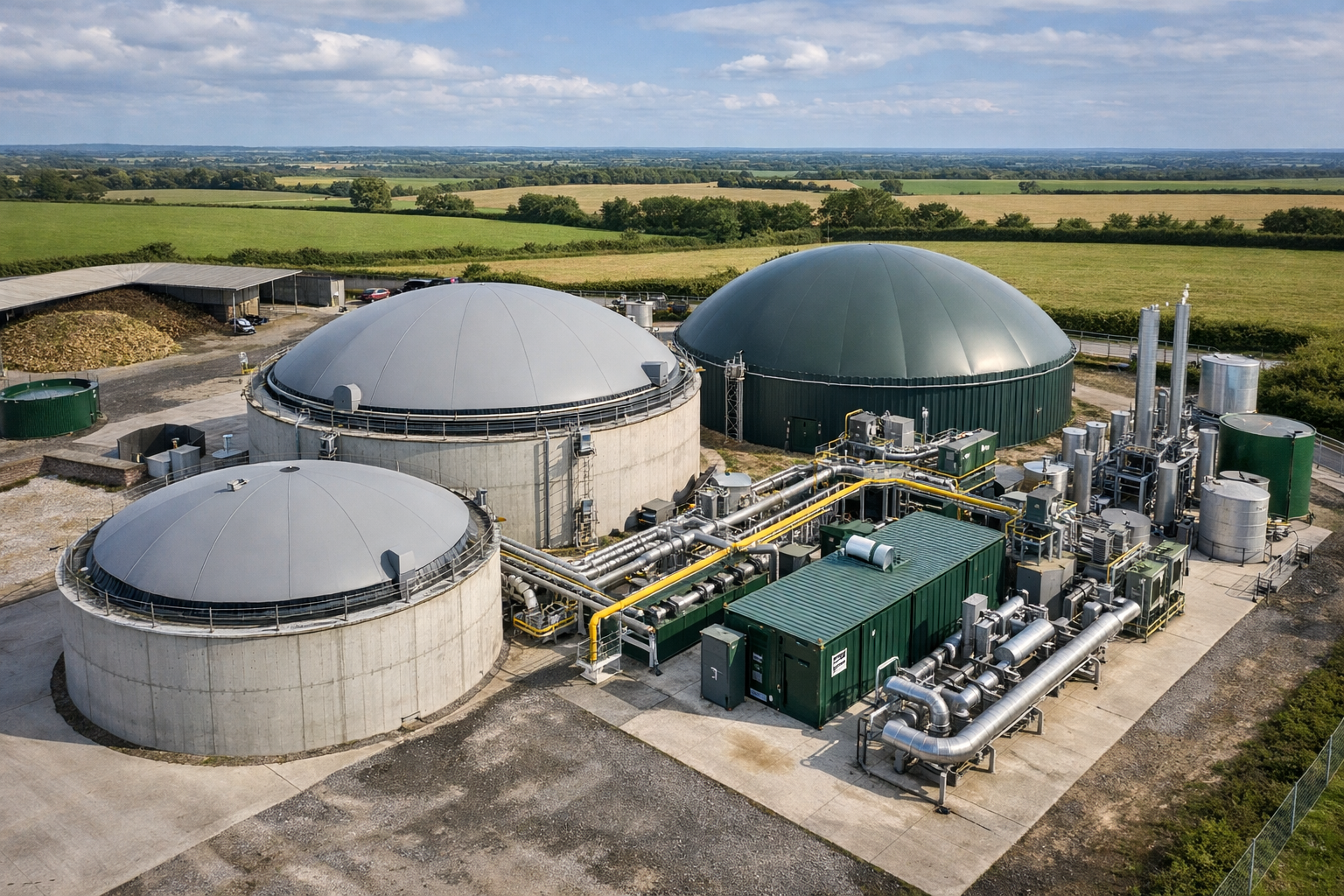
Research published in Waste Management journal found that on double-membrane dome digesters, more than half of all leakages were located at membrane fixation points. On concrete roof digesters, cracks in the concrete accounted for the majority. The average plant in that study had around five individual leak points, with some sites showing as many as 30 separate leaks.
Warning Signs You Should Not Ignore
Some leaks are obvious. Most are not. Here are the indicators that warrant a closer look, even if you cannot immediately locate the source.
Process Performance Signals
Feed-to-gas conversion is lower than expected, but digester biology appears stable. If volatile fatty acids (VFAs) and pH are in range and feedstock composition has not changed, unexplained drops in gas yield often point to losses somewhere in the gas handling system.
Gas holder pressure is inconsistent between readings without a clear operational reason.
Biogas yield figures are declining gradually without a corresponding change in feedstock, retention time, or temperature.
Sensory Indicators
You can smell biogas. Biogas is typically odourless in its pure methane form, but it contains trace quantities of H₂S and other compounds that produce a detectable smell, particularly around digester covers, pipework, or gas handling areas. Any persistent smell warrants investigation.
Visible corrosion or staining around flanges, valve connections, or digester walls, which can indicate long-term H₂S exposure.
Membrane covers that appear deflated or misshapen, or show visible creasing around fixation points.
Operational Triggers
The plant has just completed a significant maintenance activity, such as manway access, agitator replacement, or pipework modification.
A new feedstock has been introduced and gas yields have not responded as expected.
The plant is approaching its first full year of operation, or has passed a significant operating milestone.
Quick Tip
The best times to commission a leak detection survey are at the start of full plant operation, after significant maintenance work, and whenever feed-to-gas conversion drops without a clear biological explanation. Regular scheduled surveys, typically every six to twelve months, are now considered industry best practice and are referenced in the ADBA Certification Scheme.
Detection Methods: From Simple Checks to Specialist Surveys
The approach to leak detection should match the scale of the concern. A quick site check after maintenance is different from a comprehensive LDAR survey on a large commercial plant. Here is how the main methods compare.
| Method | How it works | Best for | Limitations |
|---|---|---|---|
| Soap solution / bubble test | Apply soapy water to suspected joints or connections; bubbling indicates gas escape | Targeted checks on specific fittings after maintenance | Only identifies suspected areas; misses wider plant leaks |
| Portable gas detector | Handheld electrochemical or catalytic sensor measures methane concentration at specific points | Routine operator walkdowns, confined space entry checks | Operator-dependent; cannot easily quantify emission rates |
| Fixed point gas detection | Permanently installed CH₄ and H₂S sensors in key plant areas with continuous monitoring and alarm outputs | Ongoing safety monitoring, confined spaces, CHP enclosures | Monitors fixed locations only; not a substitute for LDAR surveys |
| Optical Gas Imaging (OGI) | Infrared camera makes methane gas visible as a “smoke-like” cloud; can cover large areas quickly | Full plant LDAR surveys, post-maintenance checks, rapid incident response | Requires specialist operator and ATEX-rated equipment on live sites |
| Gas Organic Vapour Analysis (OVA) | Combined with OGI to quantify leak rates in grams or litres per hour at specific leak points | Detailed LDAR reporting, regulatory submissions | Time-intensive; typically used alongside OGI rather than standalone |
Optical Gas Imaging (OGI) has become the industry standard for comprehensive AD plant surveys. Cameras such as the EyeCGas 2.0 use thermal imaging to render methane gas visible, allowing surveyors to scan large structures quickly and identify leaks that would be impossible to find with portable detectors alone. A full LDAR survey using OGI typically takes around half a day on site and produces a detailed report including images, videos, and a severity grading for each leak found.
It is important that any OGI survey on a live AD site is carried out by operators with ATEX competency, given that parts of the plant will be within classified explosion zones.
Assessing Severity and Prioritising the Response
Not every leak demands an immediate shutdown. A proportionate response depends on the leak's location, its emission rate, and the proximity of ignition sources or confined spaces. In practice, leaks typically fall into three broad categories:
| Severity | Typical Emission Rate | Response | Who Handles It |
|---|---|---|---|
| Minor | Below 100 litres CH₄ / hour | Schedule repair within planned maintenance window; monitor in the interim | On-site team, with appropriate guidance |
| Medium | 100 to 1,000 litres CH₄ / hour | Repair within days; may require specialist parts or external support | Operations team and specialist contractor |
| Significant | Above 1,000 litres CH₄ / hour | Immediate investigation; temporary measures while permanent repair is planned; consider risk to personnel and plant safety | Specialist contractor; consider notifying permit authority |
Repair Approaches: Matching the Fix to the Failure
The right repair method depends on where the leak is, how severe it is, and whether the plant can be taken offline. Some repairs are straightforward and can be carried out by trained on-site personnel. Others require specialist materials, equipment, or contractors with confined space and ATEX competency.
Temporary and Live-Plant Repairs
Where a plant cannot be shut down and a leak needs to be contained while a permanent repair is planned, some options are available for live-plant use. Hydrophilic polyurethane injection grouts can be injected into interstitial spaces and cracks in concrete digesters, where they react with moisture and expand to form a pressure-tight seal. This approach has been used successfully on HDPE-lined digesters where the liner has separated from the concrete substrate, creating a migration path for gas.
For pinhole leaks in bioreactor roofs, industrial sealants such as high-performance polyurea or Belzona-type compounds have been used to provide a temporary seal, allowing operations to continue at reduced pressure while a permanent repair is scheduled. Any live-plant repair must be carried out with appropriate gas detection and in line with the site's ATEX risk assessment.
Planned Offline Repairs
Where the severity of the leak or the nature of the repair requires the digester to be taken offline, there is more flexibility in material choice. Spray-applied polyurea membranes can be applied seamlessly around penetrations and across joints, providing a long-term gas-tight solution. Membrane replacement or refixation on double-membrane dome digesters is a specialist task requiring the correct materials and anchoring system.
Flange and gasket replacement is often straightforward once the plant section can be isolated and depressurised. Care should be taken to use materials rated for biogas service, as standard plumbing gaskets and sealants may not be compatible with the hydrogen sulphide content of digester gas.
BIOCON perspective:
A good LDAR survey does not just identify leaks. It produces a prioritised repair list with severity gradings, exact leak locations, emission rate estimates, and recommended actions. That information lets operators and their contractors plan efficiently, batch repairs sensibly, and allocate budget where it has the most impact. It also builds an audit trail for the environmental permit and any relevant certification scheme.
Considerations Across Different Plant Types
While the core principles of leak detection apply across all AD plants, some considerations differ depending on the feedstock and plant configuration.
Agricultural and farm-based plants often have large digester volumes and significant areas of membrane roof. Cattle slurry and crop-based feedstocks tend to produce biogas steadily, which means that unexplained yield drops are relatively easy to spot against a stable baseline. However, access for inspection surveys can be more complex due to site layout, and seasonal temperature swings can stress membrane fixation points.
Food waste and industrial plants typically operate at higher throughput rates with more variable feedstocks. These plants often have more pipework complexity and more mechanical interfaces, meaning more potential leak points. Agitator shaft seals and the connections between depackaging equipment and the digester feed system deserve particular attention.
Municipal and sewage treatment plants often have concrete digesters, where cracks in the roof or walls are one of the most common causes of gas leakage. These plants are also more likely to have integrated gas utilisation infrastructure, such as combined heat and power (CHP) units or gas upgrading equipment, which introduces additional leak risk in the gas supply pipework.
BIOCON On Site Checklist: Leak Awareness for Operators
Not sure which detection method is right for your plant?
We have put together a free practical toolkit to help you work through. Itcovers a scored risk self-assessment, a hotspot inspection guide, a detection method selector, and a business case builder you can share with your plant owner.
When to Bring in Specialist Support
On-site teams can and should carry out routine gas awareness checks as part of normal plant management. But there are situations where specialist support adds real value and, in some cases, where it is the only safe or effective option.
A formal LDAR survey is due (every six to twelve months is current best practice, and a permit requirement on many sites).
Gas yield has dropped unexpectedly and process chemistry has been ruled out as the cause.
A portable detector is picking up elevated readings but the source cannot be located on a walkdown.
A significant maintenance event has been completed and a post-maintenance check is needed.
The plant is approaching its first operational year and has not yet had a baseline LDAR survey.
There are signs of structural movement or cracking in a concrete digester roof or wall.
A repair has been attempted but gas readings have not returned to expected levels.
An experienced field team with OGI capability, ATEX competency, and a background in AD plant operation will identify leaks that are invisible to routine checks, quantify their severity, and provide a prioritised repair plan that can be actioned efficiently without unnecessary downtime.
Biogas leak detection is not a niche concern for plants with obvious problems. It is a standard element of responsible AD plant management. The data is clear: the majority of operating plants have some level of leakage, most of which goes undetected through routine observation alone.
Getting on top of it does not require a major programme. It starts with operator awareness, a structured walkdown approach, and a scheduled LDAR survey from a competent specialist. The investment is modest. The return, in recovered gas, reduced compliance risk, and safer site conditions, typically pays back quickly.
Need support with leak detection or LDAR on your site?
BioConsult provides site-based operational support across all AD plant types, including planned and reactive leak detection, LDAR survey coordination, and practical troubleshooting. If your plant is showing signs of gas loss, or if you are due a scheduled survey and want a team who understands AD plant operation from the ground up, get in touch and we will talk through next steps.
